Sports Injury Rehabilitation in Belgrade
From the first days after injury to the day you are cleared to train again — assessment, hands-on treatment, progressive loading and return-to-sport testing.
- Block 64, New Belgrade
- Mon–Fri 08–20, Sat 09–15
- +381 60 503 74 77
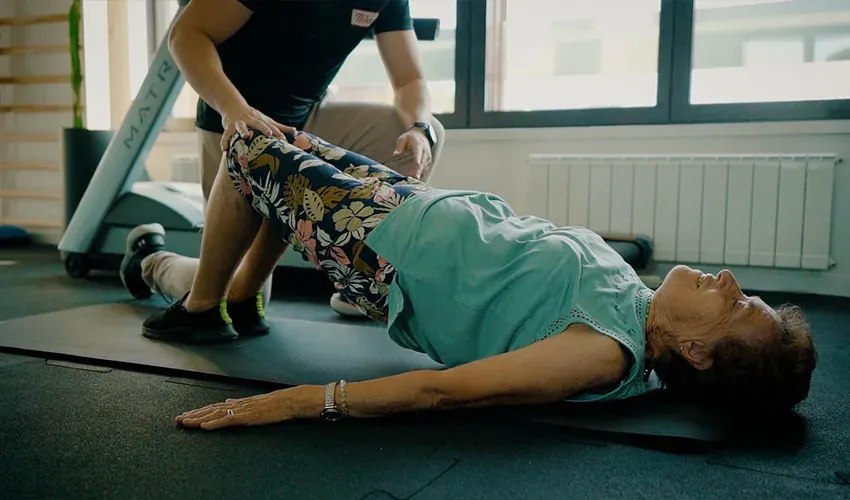
Sports injury rehabilitation at PHYSIOWRLD
Sports injuries heal on a biological timeline; whether you come back stronger or keep re-injuring depends on what you do during that time. Our sports rehabilitation programme is built around progressive loading — protecting the tissue early, restoring range and strength in the middle phase, and rebuilding power, speed and confidence before you return to training.
We work with recreational runners, footballers, basketball and tennis players, CrossFit and gym athletes, martial artists and skiers, as well as with people whose “sport” is a physically demanding job. Sessions are one-on-one, 30 minutes, with an English-speaking physiotherapist.
Where a diagnosis is unclear, we arrange ultrasound or MRI through our partner diagnostic clinic and, when needed, an orthopaedic opinion — rehabilitation is planned around a confirmed diagnosis, not a guess.
Who this service is for
- Muscle strains (hamstring, calf, quadriceps, groin)
- Tendon injuries — Achilles, patellar, rotator cuff, tennis elbow
- Ligament injuries — ankle sprain, MCL, ACL (conservative or post-op)
- Shoulder instability and impingement in overhead athletes
- Runner’s knee, shin splints and stress-related overload
- Athletes returning after surgery who need a structured return-to-play plan
What happens at your first visit
- 1
Injury history: mechanism, when it happened, what you have done so far, previous injuries to the same area and your training schedule.
- 2
Examination: range of motion, strength testing against resistance, ligament stability tests, palpation and — where relevant — functional tests such as single-leg hop or squat mechanics.
- 3
Plan: the phase you are in, what is allowed and what is not, an estimated timeline and the criteria you need to meet to progress. Treatment starts the same day.
What treatment looks like
- Early phase: swelling control, pain-free range of motion, isometric loading, high-intensity laser or electrotherapy where it helps.
- Middle phase: progressive strengthening, manual therapy and Active Release for restricted tissue, balance and neuromuscular control.
- Late phase: plyometrics, running and change-of-direction progressions, sport-specific drills.
- Return-to-sport: strength symmetry, hop and agility testing before clearance, and a plan for the first weeks back in training.
Duration, number of sessions and prices
Sessions are 30 minutes. A grade I muscle strain may need 3–5 sessions over two weeks; an ankle sprain 6–8; a tendinopathy 8–12 over 2–3 months; post-operative cases longer. Frequency is highest in the first two weeks and reduces as you take over more of the work independently.
| Service | Duration | Price |
|---|---|---|
| Kinesitherapy (one-on-one guided exercise)10 sessions – 30,000 RSD | 30 min | 3,500 RSD |
| Physical therapy (assessment + device therapy + manual techniques)10 sessions – 20,000 RSD | 30 min | 2,500 RSD |
| Active Release technique | 30 min | 4,000 RSD |
| Shockwave therapy (radial ESWT)5 sessions – 13,500 RSD | 15–20 min | 3,000 RSD |
| Sports massage | 30 / 60 min | 3,500 / 5,000 RSD |
Prices are in Serbian dinars (RSD), identical for all patients. See the full price list in English.
Conditions we treat
- Hamstring, calf and groin strains
- Achilles tendinopathy and calf–Achilles overload
- Patellar tendinopathy (jumper’s knee) and runner’s knee
- Lateral ankle sprain and chronic ankle instability
- Meniscus and MCL injuries; ACL — conservative and post-reconstruction
- Shoulder impingement, rotator cuff tendinopathy and instability
- Tennis and golfer’s elbow
- Shin splints (medial tibial stress syndrome)
Contraindications — when you need a doctor first
Physiotherapy is safe for most people, but some situations require a medical assessment before or instead of treatment. Contact a doctor or emergency service if any of the following apply:
- Suspected fracture, complete tendon rupture or joint dislocation — emergency assessment and imaging first
- A knee that gives way, locks or cannot fully straighten after injury — orthopaedic review before loading
- Rapidly increasing swelling, warmth and fever
- Calf pain with swelling after a long flight or immobilisation — rule out thrombosis before treatment
The four phases of sports rehabilitation
| Phase | Goal | Typical content | Progress when |
|---|---|---|---|
| 1. Protect | Control pain and swelling, keep moving safely | Relative rest, isometrics, laser/electrotherapy, gentle range of motion | Pain-free walking, swelling stable |
| 2. Restore | Full range and baseline strength | Progressive resistance, manual therapy, balance work | Full ROM, strength ≥ 70% of other side |
| 3. Rebuild | Power, speed, endurance | Plyometrics, running progressions, sport-specific loading | Strength ≥ 90%, hop tests symmetrical |
| 4. Return | Safe return to full training and competition | Team or sport drills, load monitoring, maintenance programme | Cleared on testing and confidence |
Shockwave therapy for stubborn tendon injuries
Chronic tendinopathies of the Achilles, patellar tendon, plantar fascia and lateral elbow that have not responded to 8–12 weeks of loading often respond to radial shockwave therapy (3–5 sessions, 3,000 RSD each) combined with continued exercise. Shockwave is not used in the acute phase or on a recently injured muscle.
Sports massage and recovery
Sports massage (30 minutes 3,500 RSD, 60 minutes 5,000 RSD) is available for training recovery and pre-competition preparation. It complements rehabilitation but does not replace strengthening — a tight muscle that keeps returning is usually a weak or overloaded one.
Your team
Licensed physiotherapist
Leads assessments, kinesitherapy and post-operative rehabilitation. Consultations in English.
Ackerman chiropractor
Manual therapy and spinal adjustments after a structured clinical screening.
Location, parking and opening hours
PHYSIOWRLD — Block 64, New Belgrade
Omladinskih brigada 96E/4, 11070 Novi Beograd, SerbiaGet directionsParking: Free street parking directly in front of the building; a public garage is a 2-minute walk away.
Opening hours
- Monday – Friday: 08:00–20:00
- Saturday: 09:00–15:00
- Sunday – closed
Frequently asked questions
- How soon after an injury should I come in?
- Within the first 2–5 days, once a fracture or serious structural injury has been excluded. Early guidance on what to load and what to protect shortens the total recovery time.
- Do you provide return-to-sport testing?
- Yes. Before clearance we test strength symmetry, single-leg hop and, where relevant, agility and change-of-direction, and give you the results in writing.
- How much does sports injury rehabilitation cost?
- Kinesitherapy sessions are 3,500 RSD (10 sessions 30,000 RSD); physical therapy sessions with device treatment are 2,500 RSD. The assessment is part of the first session.
- Can I keep training while injured?
- Usually yes, with modifications. Part of the first visit is agreeing what you can safely continue — cycling instead of running, upper-body work during a lower-limb injury, and so on.
- Do I need an MRI before starting?
- Not always. Many injuries are diagnosed clinically. If the examination suggests a structural tear or the recovery does not follow the expected course, we arrange imaging through our partner clinic nearby.
- Do you work with athletes who had surgery abroad?
- Yes. Bring your surgeon’s protocol and operative report; we continue rehabilitation from your current phase and respect the restrictions set by the surgeon.
- Is the physiotherapist English-speaking?
- Yes — assessment, exercise coaching and written programmes are in English.
Book an appointment in English
Send a short WhatsApp message describing the problem and your preferred times, or use the booking form. We usually reply within a few hours during opening hours.