Chiropractic and Manual Therapy in Belgrade
Spinal and joint adjustments performed by a trained Ackerman chiropractor, always after a screening — and combined with physiotherapy when that gives a better result.
- Block 64, New Belgrade
- Mon–Fri 08–20, Sat 09–15
- +381 60 503 74 77
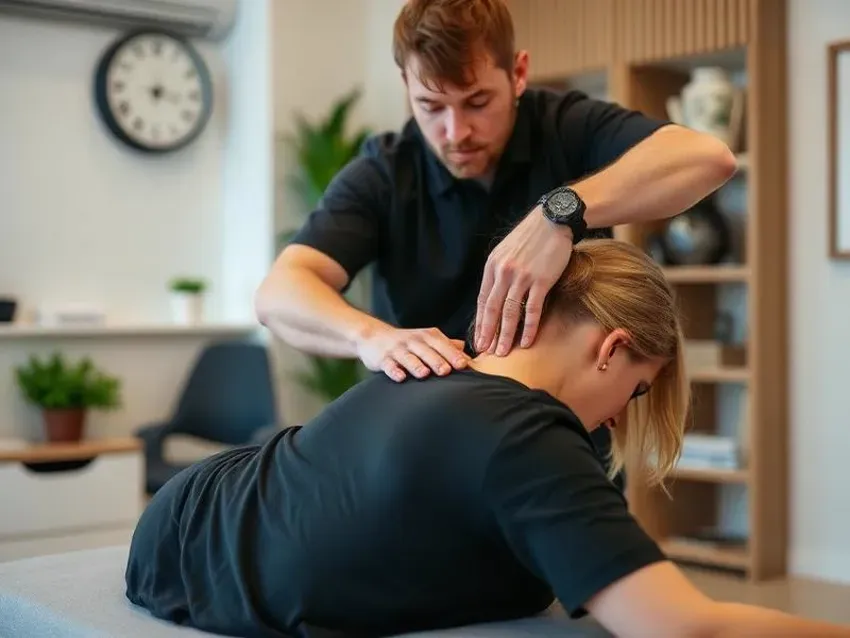
Chiropractic adjustment at PHYSIOWRLD
Chiropractic at PHYSIOWRLD is a 30-minute appointment with Stefan Miljković, an Ackerman-method chiropractor, working inside a physiotherapy clinic. That setting matters: every adjustment is preceded by a screening for red flags, and if your problem is better served by exercise, manual soft-tissue work or shockwave, you are told so and treated accordingly rather than adjusted by default.
The Ackerman method is a structural technique that focuses on the pelvis, sacroiliac joints and spine, using low-amplitude, precisely directed thrusts. It is commonly used for mechanical low back pain, restricted spinal segments, pelvic asymmetry and neck stiffness.
We describe what chiropractic can and cannot do honestly. Manual adjustment can reduce pain and restore movement in a mechanically restricted joint. It does not “put a disc back”, and it does not cure herniated discs, arthritis or nerve compression — those conditions need a medical diagnosis and, usually, a combined plan.
Who this service is for
- Mechanical low back pain and stiffness without neurological signs
- Sacroiliac joint pain and pelvic asymmetry
- Neck stiffness and tension-type headache of cervical origin
- Thoracic (mid-back) stiffness from desk work
- Recurrent “locking” of the back after bending or lifting
- Patients whose imaging has excluded a serious cause and who want a manual approach
What happens at your first visit
- 1
History and screening: the chiropractor asks about the onset, radiation of pain, numbness or weakness, previous imaging, osteoporosis, anticoagulant use and other factors that decide whether manipulation is safe.
- 2
Physical examination: posture, leg-length and pelvic alignment, spinal segment mobility, neurological screen (reflexes, sensation, strength) and orthopaedic tests.
- 3
Treatment in the same visit when appropriate. If the screening raises a concern — for example signs of nerve root compression — you are referred for imaging or medical review before any adjustment.
What treatment looks like
- Soft-tissue preparation of the paraspinal muscles and hips.
- Ackerman-method adjustment of the pelvis and the restricted spinal segments — controlled, specific, low-amplitude thrusts. The audible “click” is gas release in the joint, not bone moving.
- Mobilisation without thrust for patients where high-velocity techniques are not appropriate (older adults, anxiety, osteopenia).
- Two or three stabilisation exercises so the correction holds between visits.
Duration, number of sessions and prices
The appointment lasts 30 minutes. Acute mechanical back pain often improves within 1–3 sessions. Chronic or recurrent problems typically follow a plan of 4–6 visits, spaced 5–10 days apart, usually combined with kinesitherapy so that the stabilising muscles do the long-term work. We do not sell open-ended “maintenance” packages.
| Service | Duration | Price |
|---|---|---|
| Chiropractic – manual adjustment (incl. screening) | 30 min | 5,000 RSD |
| Physical therapy (assessment + device therapy + manual techniques)10 sessions – 20,000 RSD | 30 min | 2,500 RSD |
| Kinesitherapy (one-on-one guided exercise)10 sessions – 30,000 RSD | 30 min | 3,500 RSD |
| Active Release technique | 30 min | 4,000 RSD |
Prices are in Serbian dinars (RSD), identical for all patients. See the full price list in English.
Conditions we treat
- Acute and chronic mechanical low back pain
- Sacroiliac joint dysfunction
- Cervicogenic headache and neck stiffness
- Thoracic spine stiffness and rib joint restriction
- Postural pain from prolonged sitting
- Pelvic asymmetry and functional leg-length difference
Contraindications — when you need a doctor first
Physiotherapy is safe for most people, but some situations require a medical assessment before or instead of treatment. Contact a doctor or emergency service if any of the following apply:
- Osteoporosis or long-term corticosteroid use (thrust techniques are not used)
- Recent fracture, spinal surgery or spinal instability
- Progressive neurological deficit: worsening weakness, numbness, bladder or bowel changes — this needs urgent medical assessment
- Inflammatory arthritis in an active flare, infection or tumour in the spine
- Anticoagulant therapy or bleeding disorders (individual assessment)
- Vertebral artery symptoms (dizziness, visual disturbance on neck rotation) — cervical manipulation is not performed
- Pregnancy: pelvic techniques only after individual assessment; some patients are better served by physiotherapy
Chiropractor or physiotherapist — which do you need?
For a stiff, “locked” back or neck without leg or arm symptoms, chiropractic adjustment often gives the fastest relief. For pain that radiates below the knee or elbow, pain after surgery, tendon problems or general deconditioning, physiotherapy is the primary treatment and manipulation is, at most, an adjunct.
Because both are delivered under one roof, you do not have to choose in advance. The screening at your first visit decides, and many patients receive both within the same plan — for example an adjustment followed by kinesitherapy in the same week.
| Situation | Usually starts with | Why |
|---|---|---|
| Sudden back lock after lifting, no leg symptoms | Chiropractic | Mechanical joint restriction responds quickly to adjustment |
| Back pain radiating below the knee, numbness | Medical review, then physiotherapy | Possible nerve root involvement — imaging may be needed first |
| Neck stiffness and desk-related headache | Chiropractic + posture programme | Restores segment mobility; exercise prevents recurrence |
| Chronic tendon pain (Achilles, elbow, heel) | Physiotherapy / shockwave | Not a joint restriction problem |
| After spinal or joint surgery | Physiotherapy | Manipulation is contraindicated early after surgery |
Is chiropractic safe?
When performed after a proper screening on an appropriate patient, spinal manipulation has a low rate of serious complications. Mild soreness for 24–48 hours after the first adjustment is common and settles on its own. Serious adverse events are rare and are associated with treating patients who should have been screened out — which is exactly why our first visit includes a neurological and vascular screen and why we decline to adjust when the criteria are not met.
Your team
Licensed physiotherapist
Leads assessments, kinesitherapy and post-operative rehabilitation. Consultations in English.
Ackerman chiropractor
Manual therapy and spinal adjustments after a structured clinical screening.
Location, parking and opening hours
PHYSIOWRLD — Block 64, New Belgrade
Omladinskih brigada 96E/4, 11070 Novi Beograd, SerbiaGet directionsParking: Free street parking directly in front of the building; a public garage is a 2-minute walk away.
Opening hours
- Monday – Friday: 08:00–20:00
- Saturday: 09:00–15:00
- Sunday – closed
Frequently asked questions
- How much does a chiropractor cost in Belgrade?
- At PHYSIOWRLD a chiropractic appointment — screening and adjustment — is 5,000 RSD for 30 minutes. If it is combined with physiotherapy, those sessions are billed at the physiotherapy rate (2,500–3,500 RSD).
- Does the chiropractor speak English?
- Yes. The screening, explanation of findings and the treatment itself are conducted in English.
- Can chiropractic fix a herniated disc?
- No. A disc herniation is a structural change that manipulation does not reverse. Manual therapy may reduce associated joint stiffness and pain in selected cases, but disc-related pain with nerve symptoms is primarily managed with physiotherapy and medical care. We assess this at the first visit and refer for imaging when needed.
- How many sessions do I need?
- Acute mechanical pain often improves in 1–3 sessions. Recurrent or chronic problems typically need 4–6 visits combined with exercise. We do not recommend indefinite maintenance adjustments.
- Does the adjustment hurt?
- The thrust itself is quick and usually painless. Some patients feel mild soreness for a day or two, similar to after unfamiliar exercise.
- Do I need an X-ray or MRI before treatment?
- Not routinely. Imaging is requested only when the screening suggests it — for example neurological signs, significant trauma, osteoporosis risk or symptoms that do not fit a mechanical pattern.
- Can I be adjusted during pregnancy?
- Only after individual assessment, using non-thrust pelvic techniques. In many cases physiotherapy is the more suitable option; we advise on the day.
Book an appointment in English
Send a short WhatsApp message describing the problem and your preferred times, or use the booking form. We usually reply within a few hours during opening hours.