ACL and Post-Operative Knee Rehabilitation in Belgrade
Phase-based rehabilitation after ACL reconstruction, meniscus repair or arthroscopy — coordinated with your surgeon, one-on-one with an English-speaking physiotherapist.
- Block 64, New Belgrade
- Mon–Fri 08–20, Sat 09–15
- +381 60 503 74 77
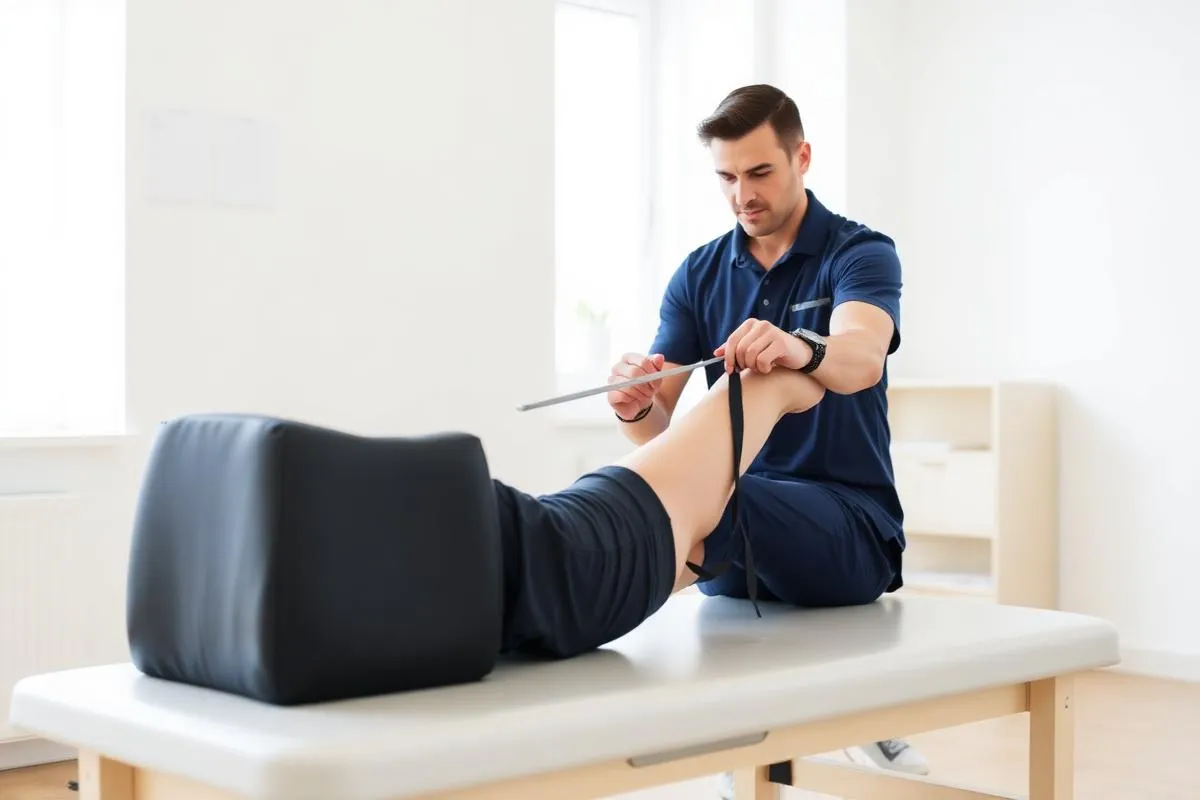
Post-operative knee rehabilitation at PHYSIOWRLD
The outcome of knee surgery is decided as much in the months of rehabilitation as in the operating theatre. After ACL reconstruction, meniscus repair or arthroscopy, the goals follow a predictable order: control swelling, regain full extension and flexion, rebuild quadriceps and hamstring strength, restore balance and control, and only then return to running, cutting and sport.
Our post-operative knee programme is delivered one-on-one in 30-minute sessions with an English-speaking physiotherapist, following the restrictions set by your operating surgeon. Patients who had surgery abroad and are recovering in Belgrade are welcome — bring your operative report and protocol.
Each phase has objective criteria for moving on. This prevents both the most common mistakes: progressing too fast on a swollen, weak knee, and staying cautious for so long that the muscle never fully returns.
Who this service is for
- After ACL reconstruction (hamstring, patellar tendon or quadriceps graft)
- After meniscus repair or partial meniscectomy
- After knee arthroscopy for cartilage or loose bodies
- After total or partial knee replacement
- Conservative (non-surgical) management of ACL or meniscus injury
- Patients whose recovery has stalled — persistent stiffness, weakness or lack of confidence months after surgery
What happens at your first visit
- 1
We review the operative report and your surgeon’s protocol, including weight-bearing status, brace instructions and any range-of-motion limits.
- 2
Examination: swelling (circumference), knee extension and flexion, quadriceps activation, gait, scar mobility and — later in rehabilitation — strength and hop testing.
- 3
You receive a written phase plan, a home programme and your first treatment. Ideally the first visit takes place within the first week after surgery, but we also take over rehabilitation at any later stage.
What treatment looks like
- Weeks 0–2: swelling control, patellar and scar mobilisation, restoring full extension, quadriceps activation (with electrostimulation if needed), gait training with crutches.
- Weeks 2–6: progressive flexion, closed-chain strengthening, stationary cycling, balance and proprioception, normalising walking.
- Weeks 6–12: heavier strength work (squat, leg press, hamstring loading), single-leg control, introduction of straight-line jogging when criteria are met.
- Months 3–6+: plyometrics, change of direction, sport-specific drills and return-to-sport testing (strength symmetry, hop battery, movement quality).
Duration, number of sessions and prices
Sessions are 30 minutes at 3,500 RSD (10 sessions 30,000 RSD). Meniscectomy and simple arthroscopy usually need 6–10 sessions over 4–6 weeks. ACL reconstruction is a 6–9-month process; most patients attend 2–3 times per week in the first 6 weeks, then weekly, with increasing independent training. Knee replacement typically requires 10–20 sessions in the first three months.
| Service | Duration | Price |
|---|---|---|
| Post-operative rehabilitation (knee, hip, shoulder, arthroscopy)10 sessions – 30,000 RSD | 30 min | 3,500 RSD |
| Kinesitherapy (one-on-one guided exercise)10 sessions – 30,000 RSD | 30 min | 3,500 RSD |
| Electrotherapy (TENS / interferential / electrostimulation)10 sessions – 20,000 RSD | 20 min | 2,500 RSD |
| High-intensity laser therapy (HILT)10 sessions – 20,000 RSD | 15–20 min | 2,500 RSD |
Prices are in Serbian dinars (RSD), identical for all patients. See the full price list in English.
Conditions we treat
- ACL reconstruction rehabilitation
- Meniscus repair and meniscectomy
- Knee arthroscopy (cartilage, loose bodies, plica)
- Total and partial knee replacement
- MCL and PCL injuries
- Patellar dislocation and stabilisation surgery
- Persistent stiffness or quadriceps weakness after knee surgery
Contraindications — when you need a doctor first
Physiotherapy is safe for most people, but some situations require a medical assessment before or instead of treatment. Contact a doctor or emergency service if any of the following apply:
- Signs of infection: increasing redness, heat, discharge from the wound, fever — contact your surgeon immediately
- Sudden calf pain and swelling — possible deep-vein thrombosis, medical assessment first
- A sudden “pop”, new instability or a rapidly swelling knee during rehabilitation — surgical review before continuing
- Progressing beyond your surgeon’s restrictions — we do not override the operating surgeon’s protocol
ACL rehabilitation milestones
| Timeframe | Key goals | Criteria to progress |
|---|---|---|
| Week 0–2 | Full extension, minimal swelling, quad activation | Extension equal to other side, straight-leg raise without lag |
| Week 2–6 | Flexion to 120°+, normal gait without crutches | No limp, swelling controlled after activity |
| Week 6–12 | Strength building, single-leg control | Quad strength ≥ 70% of other side, pain-free single-leg squat |
| Month 3–4 | Straight-line running | Strength ≥ 80%, no swelling response to loading |
| Month 4–6 | Plyometrics, change of direction | Hop tests ≥ 90% symmetry, good landing mechanics |
| Month 6–9+ | Return to sport | Strength and hop symmetry ≥ 90%, sport-specific testing, psychological readiness |
Common mistakes after knee surgery
- Accepting a knee that does not fully straighten — loss of extension is the hardest deficit to recover later.
- Judging recovery by pain alone. A pain-free knee at 3 months can still have 30% quadriceps weakness; we test rather than assume.
- Returning to sport by the calendar instead of by criteria — re-injury risk is significantly higher when strength and hop symmetry are not met.
- Stopping rehabilitation once walking is normal, usually around week 6–8, which is exactly when strength work should intensify.
Meniscus surgery and knee replacement
After a partial meniscectomy, weight-bearing is usually allowed immediately and rehabilitation focuses on swelling, range of motion and quadriceps strength over 4–6 weeks. After a meniscus repair, the surgeon typically limits flexion under load for 4–6 weeks to protect the sutured tissue — the timeline is slower and we follow it strictly.
After total knee replacement, the priorities are early extension and flexion (a target of 0–110° or more in the first weeks), controlled swelling, walking pattern and stair technique. Most patients attend 2–3 times per week initially; laser and electrotherapy are used for pain and swelling alongside exercise.
Your team
Licensed physiotherapist
Leads assessments, kinesitherapy and post-operative rehabilitation. Consultations in English.
Ackerman chiropractor
Manual therapy and spinal adjustments after a structured clinical screening.
Location, parking and opening hours
PHYSIOWRLD — Block 64, New Belgrade
Omladinskih brigada 96E/4, 11070 Novi Beograd, SerbiaGet directionsParking: Free street parking directly in front of the building; a public garage is a 2-minute walk away.
Opening hours
- Monday – Friday: 08:00–20:00
- Saturday: 09:00–15:00
- Sunday – closed
Frequently asked questions
- When should I start physiotherapy after ACL surgery?
- Ideally within the first week. Early work on swelling, extension and quadriceps activation makes the later phases easier. If you are already weeks or months post-op, we take over from your current stage.
- How long does ACL rehabilitation take?
- Return to running is usually possible around month 3–4 when strength criteria are met; return to pivoting sports typically at 6–9 months, after passing strength and hop testing. Rushing this stage is the main cause of re-injury.
- How much does post-operative knee rehabilitation cost?
- 3,500 RSD per 30-minute session, or 30,000 RSD for a package of 10. Electrotherapy or laser used within the session is included; a standalone laser session is 2,500 RSD.
- I had my surgery in another country. Can you continue my rehabilitation?
- Yes. Bring the operative report and the surgeon’s protocol. We follow their restrictions and communicate with them if something is unclear.
- Do I need a brace or crutches, and for how long?
- This is set by your surgeon and depends on the procedure. Most ACL patients stop crutches within 1–3 weeks once they can walk without a limp; braces are used variably. We help you progress off them safely.
- Can I do the exercises at home instead?
- Home exercise is an essential part of the plan, but supervised sessions are where we test, correct technique and progress the load. Most patients do best with 1–3 supervised sessions per week plus a daily home programme.
- When can I drive after knee surgery?
- For a right knee, usually when you can walk without crutches and perform an emergency stop comfortably — often 2–4 weeks after arthroscopy and 4–6 weeks after ACL reconstruction. Confirm with your surgeon and insurer.
- Do you offer return-to-sport testing?
- Yes — isometric strength symmetry, a single-leg hop battery and movement-quality assessment, with a written report you can share with your coach or surgeon.
Book an appointment in English
Send a short WhatsApp message describing the problem and your preferred times, or use the booking form. We usually reply within a few hours during opening hours.